
Finding Residents Across Massachusetts
There is no single roll of everyone who lives in Massachusetts. Start with the public record that best matches your question, then check its limits. A tax card names an owner, a voter list describes eligible registered voters, and a directory records a household at the time it was printed. None is a full list of today’s residents. The state has 351 cities and towns, each with its own clerk, assessor, elections office, library, and local records. Use the Massachusetts city and town directory to identify the municipality before looking for its local custodian.
A useful first pass is simple. Note whether you have a person, a current address, or an older date. Match the result to the right municipality, then confirm it through a second office or record set. Keep the record date with the result. A name match alone can point to a different person, and an owner’s mailing address is not proof that the owner lives on the parcel.
- For a known address, open the parcel in the Massachusetts Interactive Property Map and note the displayed owner and tax fields.
- For your own registration status, use the Secretary of the Commonwealth voter tool; for a lawful public-list request, contact the local election office.
- For a deed or mortgage, choose the Registry of Deeds district that serves the town and search the parties, property, or book and page.
- For an older household, ask the State Library or local library for the right directory year and format.
When a record is not online, call the custodian to confirm where it is held. A written request under Massachusetts Public Records Law can seek an existing public record, subject to exemptions and redactions.
Who Keeps Massachusetts Resident Records
Massachusetts divides records by subject rather than placing them in one county clerk’s office. The Secretary of the Commonwealth oversees 21 Registry of Deeds districts. Municipal assessors hold current tax cards. City and town clerks issue local vital records, while Trial Court clerks and Registers of Probate hold court filings. County government has ended in much of the state, but county labels remain important for probate, registries, and sheriffs. Choose the office by record type and municipality.
Registry of Vital Records
150 Mount Vernon St.
Dorchester, MA 02125
617-740-2600
Research room by reservation
Massachusetts Land Records
21 registry districts
Choose a district by municipality
Public search and scanned records
For current property values and ownership, the local assessor is the primary source. The statewide map helps connect an address to a parcel, but it does not replace the municipality’s latest card. The Massachusetts street record walkthrough follows that address chain in more depth.
Current Resident Sources across Massachusetts
A Massachusetts residents directory is assembled from records that serve different purposes. Some are public lookup tools; others are held by a local office or library. Read the access note before you treat an entry as a current address. A land filing names parties to a transaction, not everyone who lives at a parcel.
| Record source | What it may show | Custodian | Access route |
|---|---|---|---|
| Property tax parcel | Owner, site address, tax mailing address, value, and sale fields | Municipal assessor; MassGIS statewide extract | Map or local property card |
| Voter record | One person’s registration status; local lists have public and withheld fields | Secretary of the Commonwealth and local election office | Self-check or town list request |
| Land-record index | Grantors, grantees, deeds, mortgages, and related filings | Registry district | Free portal, public terminal, or older books |
| Historical directory | Names, addresses, occupations, and household clues for a printed year | State and local libraries, archives | Catalog, microform, or reading room |
| Commercial people-search listing | May combine public and private data, with varying dates and accuracy | Private vendor | Check the original public custodian |
The Massachusetts voter status page is an individual self-check, not a way to browse a street. Local election offices can provide eligible public lists, but confidential voters and some other categories are excluded. A statewide voter file is not open to general public browsing. The Secretary’s voter-information rules explain the difference between local lists and that statewide file.
Choose a Massachusetts Town First
Massachusetts has 14 county names, but the county is not always the right first search field. Many county governments were abolished, and a Registry district may split a county or serve part of one. Towns still keep many day-to-day records. Identify whether an address is in a city or town, then check that municipality’s assessor, clerk, and election office. The postal city can differ from the legal municipality, so a ZIP result alone may point you to the wrong counter.
For a house near a town line, compare the parcel’s site address with the municipal assessor and the current postal result. A road name may cross the line. A neighboring Registry district can hold an older deed even when the mailing address uses another town name. Keep the municipality, ZIP, and record custodian in separate notes instead of treating them as one location.
Open a Massachusetts Parcel
The Massachusetts Interactive Property Map searches an address, then asks you to select a parcel to see its attributes. A pin or type-ahead match is only a starting point. Click the parcel itself and read the field names before copying an owner, value, or sale date. The statewide view covers all 351 municipalities, though the data year and update date depend on local delivery.
MassGIS says the parcel layer can include the site address, owner name, tax mailing address, assessed values, use code, lot size, sale date, sale price, ZIP, building area, units, and Registry book/page references. Some values are blank or stale if the local file is older. For the newest tax card or an owner-name search, use the town assessor. Statewide boundaries are helpful for research, but they are not a legal survey.
Massachusetts Site and Tax Addresses
One MassGIS field can send a search in the wrong direction if it is read as a resident list. SITE_ADDR marks where the land lies. OWN_ADDR, OWN_CITY, OWN_STATE, and OWN_ZIP describe where a tax notice is mailed. The owner may live somewhere else, and the parcel record usually says nothing about who else lives at the property.
Use the tax address as a lead for a deed or another public source, not as proof of occupancy. The Department of Revenue’s MassGIS parcel-field reference defines these columns and lists the fiscal-year data. This is the useful address check across Massachusetts because the standardized state file combines local assessor data without making every town’s card identical.
Massachusetts Deed Index Paths
Massachusetts uses 21 Registry of Deeds districts. Pick the district that serves the municipality before searching, then choose a record group such as Recorded Land, Registered Land, or plans. Search modes can include a person or company name, property address, document, book, recording date, or an unindexed-property route. The search may return an index entry and a scanned image, but the index alone is not the deed.
The Massachusetts Land Records selector is the state starting point. District coverage differs. Suffolk’s web name index begins in 1973, while older images reach back to 1800 through its unindexed search. Many older deeds lack a consistent street address, so a prior owner’s name or a book-and-page citation can work better. The screenshot below shows the district selection and the path into the records.
The statewide Registry of Deeds portal outlines the registry selector, book and page references, scanned images, and microfilm route.
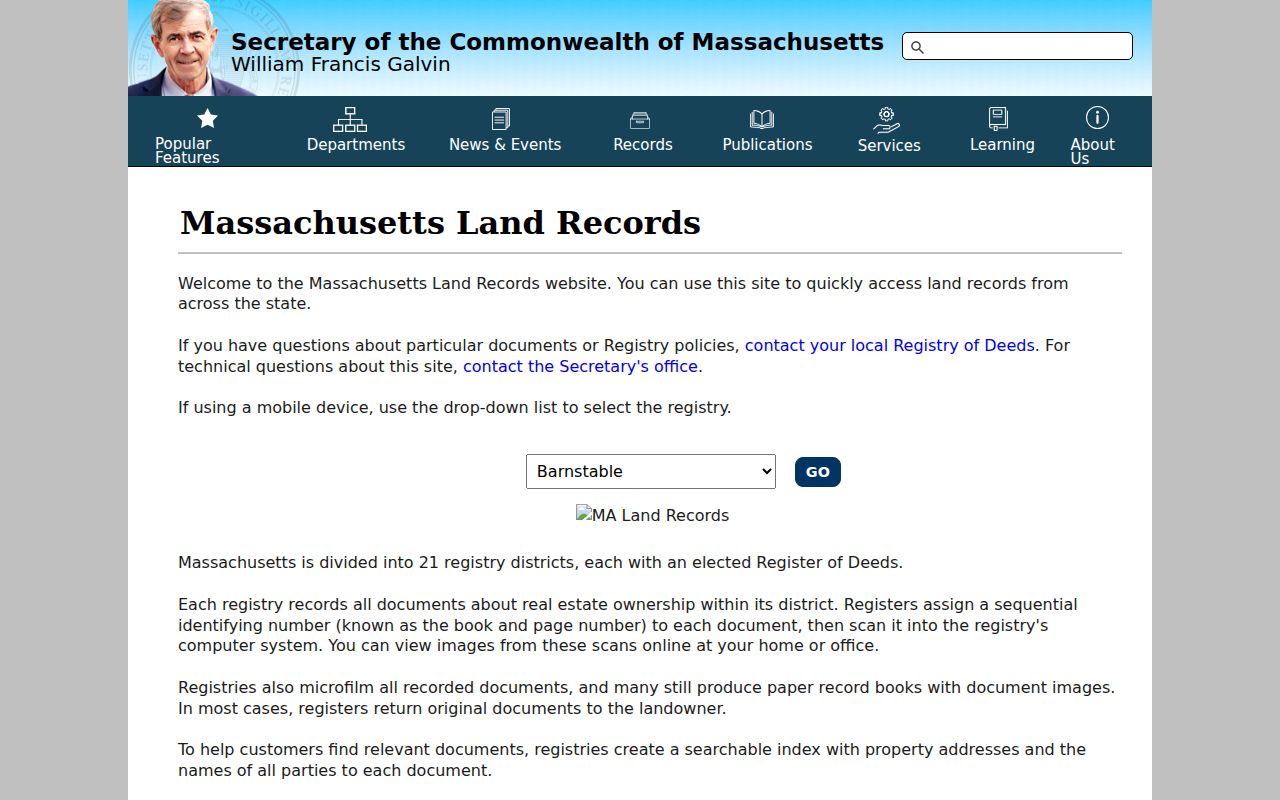
Once you choose the right Registry, compare the recorded date, party role, book and page, and image. Older records may need a public terminal, Registry staff, or microfilm when the online index does not reach the right year.
Massachusetts Voter Records Differ
The Secretary of the Commonwealth’s voter-status tool is built for a person checking their own registration. It asks for first and last name, date of birth, a five-digit residential ZIP, and an acknowledgement. The result is a status check, not a list of everyone at a street address. A miss can reflect an input or record issue and should be raised with the local election office.
A public local voter list is different. It can contain a voter’s name, address, party, birth date, registration and activity dates, and other voting-history fields. Phone, email, veteran status, permanent absentee status, confidential voter records, and minors’ records are withheld. Ballot choices are secret. The common mistake is to assume that one public tool exposes a statewide household roll; Massachusetts keeps local list access and the statewide file under separate rules.
| First and last name | Person fields used by the status form. |
|---|---|
| Date of birth | Required identity-match field. |
| Residential ZIP | Five digits for the voter’s residence, not a mailing ZIP substitute. |
| Acknowledgement | Checkbox required before the search is sent. |
For another person’s local list, ask the city or town election office about its format and exclusions. The Secretary does not make the statewide voter file generally available to the public.
Massachusetts Court Name Searches
MassCourts lets the public search many Trial Court civil dockets by party name, case number, case type, or ticket and citation number. A name search needs at least two characters for the last name and one for the first. Company names have a separate field. Choose a department and division before running the search, then check pagination and sort the returned rows. The same case can appear more than once because each party has a row.
Remote access is narrower for criminal records. The public website generally limits criminal-name searches, while a public courthouse terminal can show more when the record is open. Adoption, juvenile, sealed, impounded, and other protected matters remain out of ordinary public view. Probate & Family Court’s current remote-access order lists case types and information hidden from online users, including party addresses.
When an open case does not appear online, use a public terminal in a courthouse or Registry of Deeds location, then contact the clerk or Register where it was filed. Document access varies by department. A result row can be a lead, but the case docket or official copy is the source to cite.
Probate Records Can Confirm Kin
Probate files are useful when a name search is really a family or estate question. Massachusetts has 14 Probate & Family Court divisions. An estate docket may name a personal representative, attorney, heirs, and key filings; a will or appointment paper can show the link between a deceased person and relatives. Historic probate indexes are county-based, and early files may be with the Massachusetts Archives or Judicial Archives rather than an online page.
Search the public court portal first, then contact the Register of Probate in the division that held the case for a copy or older file. A name or result row is not the same as a certified record. If an online result is missing, a clerk or public terminal may be the next stop. Probate helps connect a person to an estate, but it does not prove where that person lived on every date in the file.
Massachusetts Vital Records by Era
Massachusetts vital records have a clear split by year. The Archives holds statewide births, marriages, and deaths from 1841 through 1935. Its free citation search covers 1841-1910 and returns a reference that can lead to an image or a copy request. The Registry of Vital Records and Statistics holds 1936 to the present; its genealogy indexes are viewed in person at a reserved research-room visit. Local clerks also hold municipal records, and the town clerk is the route for events before statewide registration began in 1841.
Recent records have access limits under M.G.L. c. 46, § 2A. Birth and marriage records older than 90 years and death records older than 50 years fall outside that restriction; current records have eligibility rules. Some birth, adoption, and Social Security fields remain specially protected. For the record itself, ask the custodian about a certified copy. A search citation is not a certificate.
Request channels differ by era. The Archives accepts its certified-vital form by mail or email, charges $3 per certificate, limits a request to five, and gives an estimate of up to 12 weeks. Staff can provide scans or links for up to five unique records from 1841-1935 at no charge. Check current instructions before sending payment.
Massachusetts Directories through Time
Printed city directories can place someone in a household when modern rolls do not reach the year. Boston’s run begins in 1789, appears annually from 1820, adds a separate address section in 1930, and includes wives beside husbands in 1933. The last listed Boston editions are 1978 and 1981. These books may show a name, street address, occupation, spouse, widow status, or business entry, but an entry describes a print year and may omit people who were not listed under that name.
The State Library holds directories and voting lists for most Massachusetts communities. Boston Public Library has a deep Boston and regional collection, including phone books and microform. For other places, ask the local library for the exact year and format before assuming it has a full run. A directory entry can be paired with a census year, newspaper, or deed citation. The collection details are on the Massachusetts city directories page.
Massachusetts License and Officer Records
Some official searches connect a name to a business or license, not to a residence. The Corporations Division lets users search entities, officers, identification numbers, and filing numbers. A filing may show an officer or registered-agent address, which is a business contact and should not be treated as a home address. Certified copies and other filings go through the Division’s public channels.
The Massachusetts eLIPSE license search has individual and business modes, with fields for name, city, state, ZIP, board, license type, and number. Some health professions use a separate DPH lookup. Confirm a result with the issuing board, especially when a board moved between systems. A license record can verify a professional credential; it does not establish that a person lives at the listed work location.
An Heir’s Unclaimed Property Search
Massachusetts’ FindMassMoney database searches by name and address. A possible match can be followed by a claim workflow, where an heir or owner submits proof that connects them to the property. The Treasurer’s Unclaimed Property Division offers phone help, and the state estimates that a claim can take about 180 days. A listing points to a potential financial claim; it is not evidence that the named person now lives at the address.
Use the official Massachusetts unclaimed-property search to check a result and follow the state’s claim directions. Keep the matching name, former address, and relationship documents together. If the record belongs to a deceased relative, probate papers may be needed. Avoid paying a private caller who says a fee is required just to search a state-held name record.
Massachusetts Privacy and Record Limits
Public does not mean unlimited. The Massachusetts Address Confidentiality Program gives eligible survivors and certain protected health-care providers a substitute address and mail-forwarding route. Confidential voter registration can keep a qualifying person’s name and residence off a public street list. Sealed court files, juvenile records, adoption records, and protected vital information have their own restrictions. A town or state office must apply the law that covers the record it holds.
When an online source has no record, make a written request to the correct Records Access Officer for existing records under M.G.L. c. 66, § 10. The public-record definition and exemptions are in M.G.L. c. 4, § 7(26), with regulations at 950 CMR 32.00. Agencies generally respond within ten business days; fees can apply to staff time after the first four hours for state agencies and to copying. A written request also preserves the route to an appeal.
Use records for lawful personal, family-history, property, or civic research. Do not use names, addresses, or search results to stalk, harass, intimidate, or harm anyone.
The state’s Address Confidentiality Program and local voter-list rules explain why a name or address may not appear in a public result. Their absence is not proof that the person never lived there.
Check Dates before Naming a Resident
Different source types answer different questions. An assessor links an owner to land; a deed index records people in a transaction; a voter result describes registration; and a directory captures a household at one point in time. Compare more than one source when the answer matters. Write down the source date, municipality, field label, and any record number that lets the custodian find the same item.
Massachusetts has all these layers, but they do not merge into one verified resident list. A blank search may reflect a coverage gap, a spelling change, a missing image, or a protected record. A positive result may refer to a namesake or a mailing address. Ask the clerk, assessor, Registry, court, or archive to confirm the record before drawing a conclusion about a person.
- Parcel
- A mapped piece of land tied to assessor fields.
- Index
- A finding aid to a record, not the full record image or a certified copy.
- Criss-cross directory
- A historical listing that can be searched by address as well as by name, when a library holds that edition.