
Finding Residents Across Massachusetts
No master list of Massachusetts residents exists. Every public record answers a narrower question, so start with the one that fits. A property roll names owners. Voter rolls cover only people registered to vote. A printed city directory captures a household at one moment in time. That moment may be decades ago. The state counts 351 cities and towns. Each keeps its own clerk, assessor, elections office, library, and local records. Pin down the municipality first with the Massachusetts city and town directory. Then find the local office that holds what you need.
A resident lookup works best in steps. Decide whether you hold a name, a current street address, or just an old date. Tie the result to the right town. Then verify it against a second record or office. Always keep the record's date beside the result. A name match alone can identify the wrong person. Remember that an owner's mailing address on a tax card does not prove the owner lives on the parcel.
- For a known address, open the parcel in the Massachusetts Interactive Property Map and note the displayed owner and tax fields.
- For your own registration status, use the Secretary of the Commonwealth voter tool; for a lawful public-list request, contact the local election office.
- For a deed or mortgage, choose the Registry of Deeds district that serves the town and search the parties, property, or book and page.
- For an older household, ask the State Library or local library for the right directory year and format.
Some records never made it online. Call the custodian and ask where the record is held. A written request under the Massachusetts Public Records Law can seek any existing public record, though exemptions and redactions still apply.
Who Keeps Massachusetts Resident Records
Massachusetts splits its records by subject rather than by one county clerk. The Secretary of the Commonwealth oversees 21 Registry of Deeds districts. Municipal assessors keep the current tax cards. City and town clerks issue local vital records. Trial Court clerks and Registers of Probate hold court filings. County government has ended across much of the state. Yet county labels still matter for probate, registries, and sheriffs. Pick the office by record type and municipality.
Registry of Vital Records
150 Mount Vernon St.
Dorchester, MA 02125
617-740-2600
Research room by reservation
Massachusetts Land Records
21 registry districts
Choose a district by municipality
Public search and scanned records
For current ownership and property values, the local assessor is the first stop. The statewide parcel map links an address to a parcel, but it cannot replace the municipality's latest tax card. The Massachusetts street record walkthrough traces that address chain in more depth.
Current Resident Sources across Massachusetts
A Massachusetts residents directory draws on records built for different jobs. Some are public lookup tools. Others sit with a local office or library. Before you treat an entry as a current address, read the access note, because a land filing names only the parties to a transaction, not everyone living at the parcel.
| Record source | What it may show | Custodian | Access route |
|---|---|---|---|
| Property tax parcel | Owner, site address, tax mailing address, value, and sale fields | Municipal assessor; MassGIS statewide extract | Map or local property card |
| Voter record | One person’s registration status; local lists have public and withheld fields | Secretary of the Commonwealth and local election office | Self-check or town list request |
| Land-record index | Grantors, grantees, deeds, mortgages, and related filings | Registry district | Free portal, public terminal, or older books |
| Historical directory | Names, addresses, occupations, and household clues for a printed year | State and local libraries, archives | Catalog, microform, or reading room |
| Commercial people-search listing | May combine public and private data, with varying dates and accuracy | Private vendor | Check the original public custodian |
The Massachusetts voter status page lets one voter check their own registration. It is not a street directory. Local election offices can provide eligible public lists. Confidential voters and some other categories are excluded. A statewide voter file is not open to general browsing. The Secretary’s voter-information rules explain the difference between local lists and the statewide file. That distinction is worth understanding before any resident lookup.
Choose a Massachusetts Town First
Massachusetts has 14 county names, but the county is rarely the best first search field. Many county governments were abolished. A Registry district may split a county or serve only part of one. Towns still keep most day-to-day records. Identify whether an address sits in a city or a town. Then check that municipality’s assessor, clerk, and election office. The postal city can differ from the legal municipality. A ZIP code directory result alone may point you to the wrong counter.
Near a town line, compare the parcel’s site address against the municipal assessor. Compare it against the current postal result too. A road name may cross the line. A neighboring Registry district can hold an older deed. The mailing address may use another town name. Keep the municipality, the ZIP, and the record custodian in separate notes. Do not treat them as one location.
Open a Massachusetts Parcel
The Massachusetts Interactive Property Map searches an address. It then asks you to select a parcel to see its attributes. A pin or type-ahead match is only a starting point. Click the parcel itself and read the field names. Do this before copying an owner, value, or sale date into your notes. The statewide view covers all 351 municipalities. The data year and update date depend on local delivery.
MassGIS says the parcel layer can include the site address and owner name. It may also carry tax mailing address, assessed values, use code, lot size, sale date, sale price, ZIP, building area, units, and Registry book and page references. Some values are blank or stale where the local file is older. For the newest tax card or an owner-name search, use the town assessor. Statewide boundaries help with research, but they are not a legal survey.
Massachusetts Site and Tax Addresses
A parcel record carries two different addresses. SITE_ADDR shows where the land sits. The OWN_ADDR, OWN_CITY, OWN_STATE, and OWN_ZIP fields are different. They instead hold the mailing address for the tax notice. Those can point to another town entirely. The parcel record also stays silent about anyone besides the owner who may occupy the property. That limits its value as a resident lookup tool.
Use the tax address as a lead toward a deed or another public record. Treat it not as proof of occupancy. The Department of Revenue’s MassGIS parcel-field reference defines each column and lists the fiscal-year data. The state file combines local assessor data. That makes it a dependable address check across Massachusetts. The fields line up even when each town’s card looks different.
Massachusetts Deed Index Paths
Massachusetts runs 21 Registry of Deeds districts. Start by matching the district to the municipality. Then pick a record group, such as Recorded Land, Registered Land, or plans. Search modes cover names, companies, addresses, documents, books, recording dates, and an unindexed-property route. A hit returns an index entry plus a scanned image. The index alone is not the deed.
The Massachusetts Land Records selector is the statewide starting point. District coverage varies. Suffolk’s web name index begins in 1973. Its unindexed search reaches images back to 1800. Many older deeds carry no consistent street address. A prior owner’s name or a book-and-page citation often works better. The same Registry of Deeds portal page lays out the selector, book and page references, scanned images, and the microfilm route. Pick the district there to enter the records.
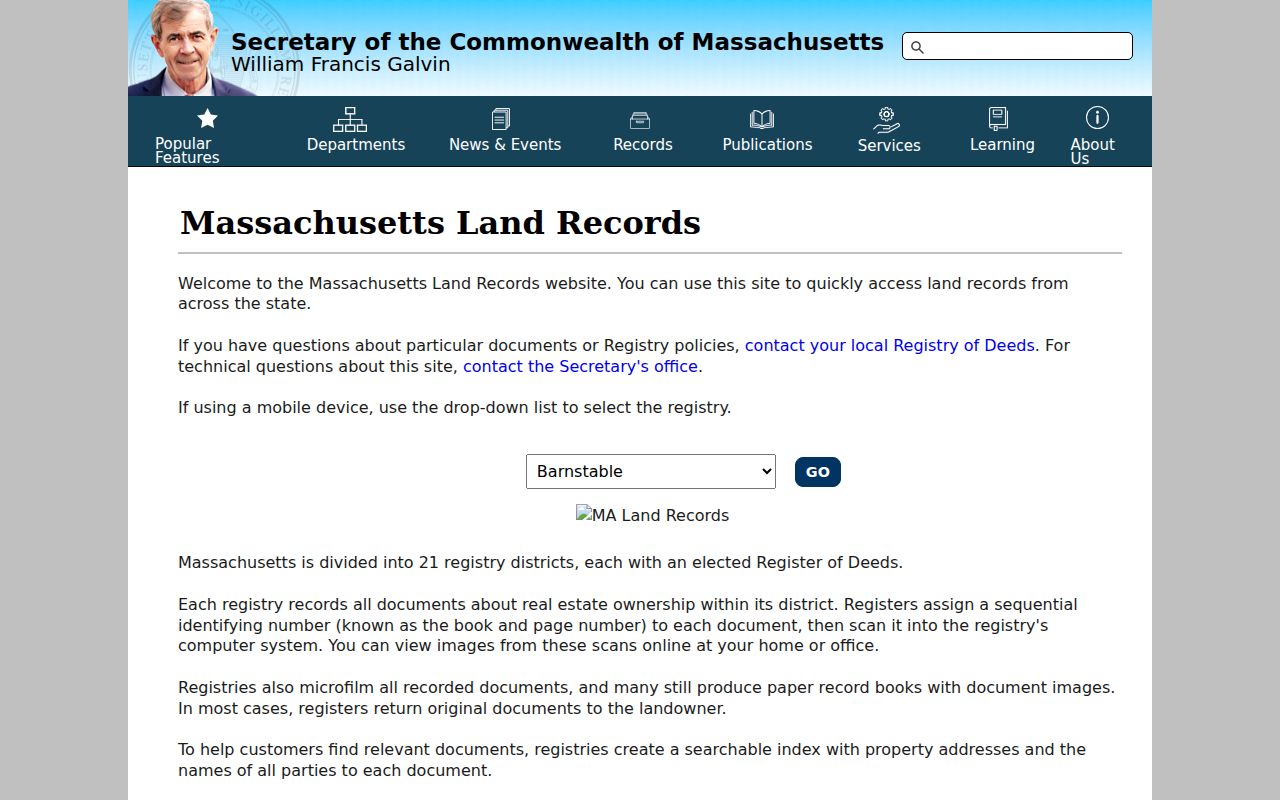
Compare everything once you pick the Registry. The date, party, book, page, and image must agree. When the online index stops short of the year you need, a public terminal, Registry staff, or microfilm can finish the job.
Massachusetts Voter Records Differ
The Secretary of the Commonwealth’s voter-status tool serves one purpose: a person checking their own registration. It asks for a first and last name. It also wants a date of birth, a five-digit residential ZIP, and an acknowledgement. The answer is a status, not a roll. No list of everyone at a street address comes back. A miss can mean an input slip or a record problem, and the local election office is the right place to raise it.
A local public voter list is a different animal. It can hold a voter’s name, address, party, birth date, registration and activity dates, and other voting-history fields. Phone, email, veteran status, permanent absentee status, confidential records, and minors’ records stay withheld, and ballot choices are always secret. The mistake is expecting a statewide household roll. Massachusetts keeps those two access paths under separate rules.
| First and last name | Person fields used by the status form. |
|---|---|
| Date of birth | Required identity-match field. |
| Residential ZIP | Five digits for the voter’s residence, not a mailing ZIP substitute. |
| Acknowledgement | Checkbox required before the search is sent. |
For another person’s entry on a local list, ask the city or town election office about its format and exclusions. The statewide voter file stays closed to the public.
Massachusetts Court Name Searches
MassCourts opens many Trial Court civil dockets to public search. Query by party name, case number, case type, or ticket and citation number. A name search needs at least two characters for the last name. It also needs one for the first. Companies get their own field. Pick a department and division first. Then run the search, mind the pagination, and sort the rows that come back. One case can appear twice, since each party gets a row.
Criminal records are narrower online. The public website generally blocks criminal-name searches. An open record can show more at a courthouse terminal. Adoption, juvenile, sealed, and impounded matters remain protected. Probate & Family Court’s current remote-access order names the case types hidden from online users. Party addresses are among them.
An open case may stay offline. If so, try a public terminal in a courthouse or Registry of Deeds location. Then contact the clerk or Register where it was filed. Document access varies by department. Treat a result row as a lead and cite the docket or official copy.
Probate Records Can Confirm Kin
A name search is sometimes a family question in disguise. Probate files answer it well. Massachusetts runs 14 Probate & Family Court divisions. An estate docket may name a personal representative, attorney, heirs, and key filings. A will or appointment paper can tie a deceased person to relatives.
Historic probate indexes follow county lines. Early files may sit with the Massachusetts Archives or Judicial Archives. They may sit there instead of an online page. Search the public court portal first. Then ask the Register of Probate in the division that held the case. Ask for a copy or an older file. A name or result row is not a certified record. If the online result is missing, a clerk or public terminal is often the next stop.
Probate can connect a person to an estate. It cannot prove where that person lived on every date in the file. So weigh it as one thread of evidence rather than a residence record.
Massachusetts Vital Records by Era
Massachusetts vital records break cleanly at 1935. The Archives keeps statewide births, marriages, and deaths from 1841 through that year, and its free citation search covers 1841 to 1910. A hit returns a reference that leads to an image or a copy request. The Registry of Vital Records and Statistics holds 1936 to the present, with genealogy indexes open only during a reserved research-room visit. Town clerks keep the municipal records. For anything before statewide registration began in 1841, the town clerk is the route.
Access limits follow the era under M.G.L. c. 46, § 2A. Birth and marriage records past 90 years fall outside the restriction. So do death records past 50. Current records carry eligibility rules, and some birth, adoption, and Social Security fields stay specially protected. A search citation is not a certificate. Ask the custodian about a certified copy.
Request channels differ by era. The Archives takes its certified-vital form by mail or email, charges $3 per certificate, limits a request to five, and quotes up to 12 weeks. Staff can send scans or links for up to five unique records from 1841 to 1935 at no charge. Check current instructions before sending payment.
Massachusetts Directories through Time
Printed city directories can place someone in a household. That helps when modern rolls stop short of a year. Boston's run starts in 1789. It goes annual from 1820. It adds a separate address section in 1930. Wives appear beside husbands starting in 1933. The last listed Boston editions are 1978 and 1981. An entry can carry rich detail. It may show a name, street address, occupation, spouse, widow status, or a business listing, but it describes one print year and can omit people not listed under that name.
The State Library holds directories and voting lists for most Massachusetts communities. Boston Public Library keeps a deep Boston and regional collection, including phone books and microform. Elsewhere, ask the local library about exact years. Never assume a full run exists. An entry pairs naturally with a census year, newspaper, or deed citation. Collection details sit on the Massachusetts city directories page.
Massachusetts License and Officer Records
Some searches tie names to businesses, not homes. The Corporations Division lets users search entities, officers, identification numbers, and filing numbers. A filing may list an officer or registered-agent address. That is a business contact. Treat it as one, not as a home address. Certified copies and other filings go through the Division's public channels.
The Massachusetts eLIPSE license search offers individual and business modes, with fields for name, city, state, ZIP, board, license type, and number. Some health professions use a separate DPH lookup. Confirm a result with the issuing board, especially where a board moved between systems. A license verifies a credential; it never proves the person lives at the listed work location.
An Heir’s Unclaimed Property Search
Massachusetts' FindMassMoney database searches by name and address. A possible match opens a claim workflow. The heir or owner submits proof connecting them to the property. The Treasurer's Unclaimed Property Division offers phone help. The state estimates a claim can take about 180 days. A listing points to money, not to a current residence. It proves nothing about where the person lives now.
Use the official Massachusetts unclaimed-property search to verify a result. Follow the state's claim directions. Keep the matching name, former address, and relationship documents together. Probate papers may be needed if the record belongs to a deceased relative. Never pay a private caller who demands a fee. That fee buys nothing for a state-held name record.
Massachusetts Privacy and Record Limits
Public access has limits. The Massachusetts Address Confidentiality Program lets eligible survivors and certain protected health-care providers use a substitute address with mail forwarding. Confidential voter registration keeps a qualifying person’s name and residence off the public street list. Sealed court files, juvenile records, adoption records, and protected vital information all carry their own restrictions. Whatever the record, the town or state office holding it must apply the law that governs that record.
No online result does not mean no record exists. Send a written request to the right Records Access Officer under M.G.L. c. 66, § 10. The definition of a public record and its exemptions sit in M.G.L. c. 4, § 7(26), with regulations at 950 CMR 32.00. Agencies generally answer within ten business days. Fees can apply to staff time after the first four hours for state agencies, and copying carries its own cost. A written request also keeps the appeal route open.
Use records for lawful personal, family-history, property, or civic research. Do not use names, addresses, or search results to stalk, harass, intimidate, or harm anyone.
The state’s Address Confidentiality Program and local voter-list rules explain why a name or address may be missing from a public result. Absence is not proof the person never lived there.
Check Dates before Naming a Resident
Each record type answers a different question. An assessor ties an owner to land. A deed index names the parties in a sale. A voter roll describes registration, and a residents directory fixes a household in time. When accuracy matters, compare several sources rather than one. Note the date, municipality, field label, and any record number. That lets the custodian pull the exact item again.
Massachusetts offers all of these layers, yet none merge into a single verified resident list. A blank resident lookup can mean a coverage gap. It could also reflect a spelling change, a missing image, or a protected record. A hit may point to a namesake or an old mailing address instead. Before concluding anything about a person, ask the clerk, assessor, Registry, court, or archive to confirm the record itself.
- Parcel
- A mapped piece of land tied to assessor fields.
- Index
- A finding aid to a record, not the full record image or a certified copy.
- Criss-cross directory
- A historical listing that can be searched by address as well as by name, when a library holds that edition.